
Commuter
Behaviour in
Mumbai Metro
Culture Probe Design /Research Paper
This project explores the differences between enforced and designed order in the Mumbai Metro. It focuses on analyzing safety systems and their impact on commuter behavior.
Role:
Field Researcher, Research Writer, Teamwork
Tools Used:
Miro, Canva, Adobe Illustrator
Concept
This project goes beyond analyzing metro systems solely through data; it examines how design subtly influences human behavior. By contrasting the staff-operated setting of Mumbai Metro Line 1 with the design-focused infrastructure of Lines 2A and 7, the research delves into how commuters interact with public spaces, establish unspoken norms, and react to visual cues. A tailored culture probe kit invited participants to record their experiences, uncovering insights that typical surveys might overlook.
24.6% commuters shifted to metro from local trains
24.1% commuters shifted to metro from public bus
19.1% commuters shifted to metro from two-wheelers
81% commuters saved a significant amount of travel time
but?
Secondary Research cited within paper.
Research Objectives
Note how commuters behave differently on staff-managed Line 1 versus design-driven Lines 2A/7.
Track how people use digital tools like m-indicator and e-tickets during travel. Also, the gradual shift from paper ticket to e-ticket.
Understand how safe and satisfied commuters feel inside the metro.
Observe how commuters deal with crowding and faster train operations.
Compare unspoken etiquette and shared responsibility across the two systems.
Research Artefacts
The probe kit used six artefacts to various aspects of daily metro travel, capturing behavioral patterns, emotional responses, environmental cues, and commuter interactions beyond research methods.
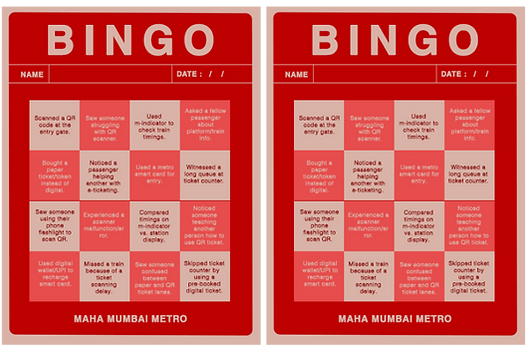
Bingo Cards
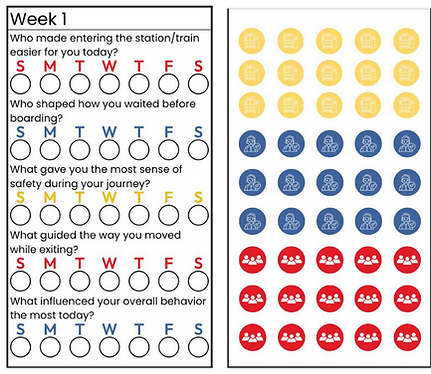
Questions with Sticker Sheet
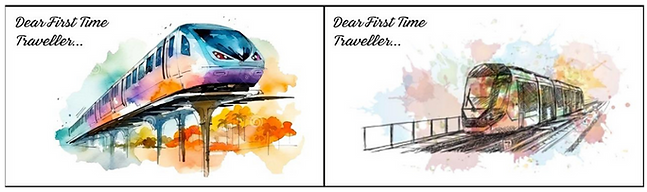

Postcard
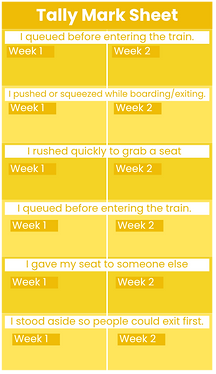
Tally Mark Sheet

Notebook
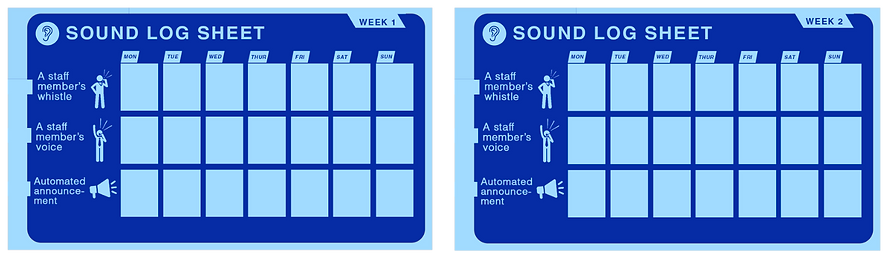
Sound Log Sheet
Conclusion
The project demonstrated that infrastructure influences more than movement. It shapes behaviour, communication and shared responsibility. By combining qualitative research with participatory methods, the study highlights how thoughtful design can foster safer, more intuitive and more considerate public spaces.